Japan's H3 rocket successfully launches Michibiki 7 navigation satellite
Japan Aerospace Exploration Agency deployed a geosynchronous positioning satellite carrying a U.S. Space Force payload on the ninth H3 mission.
Conversation activity · last 37 hours peak 2/hr
Summary, timeline and people extracted by Claude from 7 items across 4 sources · 46m ago. Quotes are verbatim.
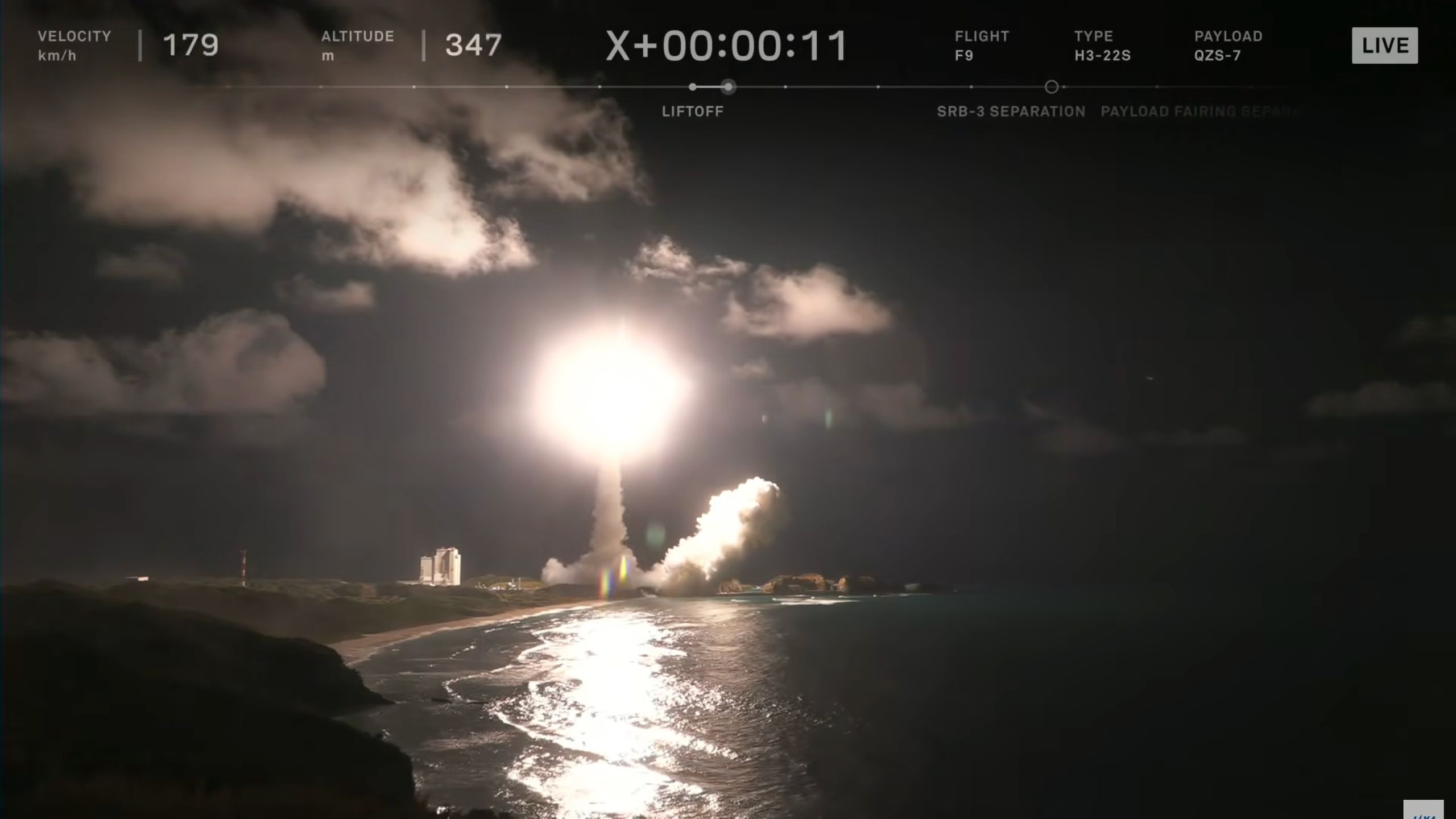
Japan's H3 rocket successfully launched the Michibiki 7 navigation satellite from Tanegashima Space Center on August 10, 2026, marking the vehicle's ninth mission and its first successful practical-use satellite deployment since a December 2025 failure. The satellite will join Japan's Quasi-Zenith Satellite System (QZSS), a homegrown navigation network compatible with GPS, and carries the Situational Awareness Camera Hosted Instrument (SACHI) payload developed for the U.S. Space Force.
- H3 successfully launched its ninth mission on August 10, 2026, ending a seven-month gap since the Michibiki 5 failure in December 2025.
- Michibiki 7 deployed to geosynchronous orbit as part of Japan's Quasi-Zenith Satellite System, which will eventually comprise 11 satellites compatible with GPS.
- The satellite carries SACHI, a U.S. Space Force payload developed by MIT Lincoln Laboratory for monitoring geosynchronous satellite activity over the Asia-Pacific region.
How it unfolded
-
Japanese news outlets confirm that the No. 9 H3 rocket was the first unit carrying a practical-use satellite since the December launch failure.
-
Space news outlets report the successful launch as the first H3 mission carrying a practical-use satellite since the December 2025 failure of the Michibiki 5 launch.
-
The H3's upper stage deployed Michibiki 7 into its target geosynchronous orbit 29 minutes after liftoff, with mission control confirming successful deployment.
“The H3's upper stage deployed Michibiki 7 into its target orbit 29 minutes later, eliciting cheers from the folks in mission control.”
Space.com · Google News ↗ -
The H3 lifted off at 3:23 p.m. EDT (1923 GMT; 4:23 a.m. local time on Aug. 11) carrying the 10,800-pound Michibiki 7 navigation satellite.
What people are saying verbatim
“The H3's upper stage deployed Michibiki 7 into its target orbit 29 minutes later, eliciting cheers from the folks in mission control.”
Space.com · Space.com ↗
“This system is compatible with GPS satellites and can be utilized with them in an integrated fashion. QZSS can be used even in the Asia-Oceania regions with longitudes close to Japan, so its usage will be expanded to other countries in these regions as well.”
Japanese officials · Space.com ↗
“This program will allow the United States to monitor satellite behavior within the GEO belt over a very interesting part of the world.”
Mark Huber, Technical staff member, Lincoln Laboratory · Space.com ↗ · Nov 30