Study maps ticklishness across cultures, finds Darwin's hypothesis partly right
Researchers surveyed 448 people in Chinese, Dutch, and Greek groups and found ticklish spots are consistent across cultures but driven by complex mechanisms.
Conversation activity · last 2 days peak 3/hr
Summary, timeline and people extracted by Claude from 10 items across 5 sources · 2h ago. Quotes are verbatim.
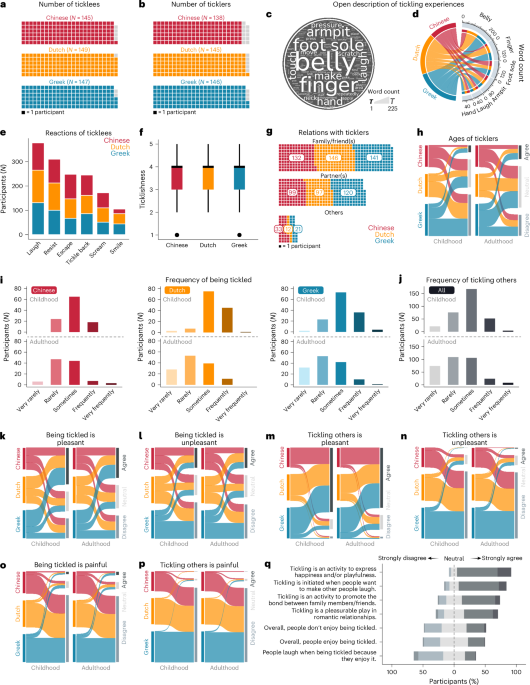
A Nature Human Behaviour study by neuroscientists Ziliang Xiong and Konstantina Kilteni surveyed 448 participants across three cultural groups and created high-resolution maps of where humans feel ticklish. The research found that armpits, feet, abdomen, and torso sides are consistently ticklish across all cultures, supporting Darwin's hypothesis that less frequently touched areas are more ticklish—but also revealing the underlying mechanism is more complex than any single historical theory can explain.
- Ticklish body areas are strikingly consistent across Chinese, Dutch, and Greek cultures, with armpits, feet, belly, and neck emerging as universal hotspots.
- Darwin's hypothesis that less frequently touched regions are more ticklish is partially supported, but the underlying mechanism is more complex than any single historical theory explains.
- Ticklishness is a distinct sensory experience, separate from pain, pleasure, and general touch sensitivity, opening new ground for systematic research.
- Nearly all surveyed participants (98.4%) reported experiencing tickling and 95.8% reported tickling others, suggesting the sensation is nearly universal in humans.
How it unfolded
-
A researcher on Mastodon shares the open-access article, noting it maps ticklishness as a culturally shared and bodily organized sensory experience.
“Human ticklishness is a widespread, culturally shared and bodily organized sensory experience”
gentlemangangster@mastodon.social · Mastodon ↗ -
The study is posted to Hacker News with a link to the full Nature Human Behaviour article.
-
A researcher shares the study on Mastodon, noting that over 95% of surveyed participants had experienced or performed tickling, with consistent ticklish spots and support for Darwin's idea about touch exposure.
“More than 95% had experienced or performed tickling, and armpits, feet, abdomen, and sides of the torso were consistently cited as the most ticklish spots across all cultures.”
tksst@fediscience.org · Mastodon ↗ -
Coverage highlights that while ticklish spots are consistent across cultures, the underlying mechanisms are more complex than previously understood.
-
Neuroscientists Ziliang Xiong and Konstantina Kilteni publish findings in Nature Human Behaviour showing that ticklish body areas are consistent across Chinese, Dutch, and Greek cultural groups.
What people are saying verbatim
“More than 95% had experienced or performed tickling, and armpits, feet, abdomen, and sides of the torso were consistently cited as the most ticklish spots across all cultures.”
tksst@fediscience.org, Researcher sharing study on Mastodon · Mastodon ↗ · Aug 11, 6:30 AM
“Although ticklishness is stronger in rarely touched regions, supporting Darwin's hypothesis, its topography relies on a psychophysiological mechanism that is more complex than previously assumed.”
Nature Human Behaviour study, Research publication · Nature Human Behaviour
“Ticklishness seems to be its own class, physiologically and psychologically. It doesn't seem that it is only a by-product or the integration of other body sensations.”
Ziliang Xiong, Study first author · Nature
“It is 'really a very poorly understood sensation'”
Michael Brecht, Neuroscientist at Humboldt University · Nature
“Human ticklishness is one of the oldest yet unresolved scientific puzzles. As early as the time of Aristotle and Socrates, scholars have speculated on its origins and function, but fundamental questions remain.”
Nature Human Behaviour study, Research publication · Nature Human Behaviour
“Studies suggest that how people interpret touch that is processed emotionally, such as hugging, can differ by cultural background”
Konstantina Kilteni, Study co-author · Nature